
Feeling Stressed Before the Day Begins? A Simple Morning Ritual to Support Your Nervous System
Have you ever opened your eyes in the morning and felt your mind switch on before your feet even touch the floor?
The to-do list starts running, your phone is within reach, and before the day has even begun, your nervous system is already on alert.
Many of my clients describe this feeling as waking up anxious, scattered or already behind. From a naturopathic and acupuncture perspective, this matters because the way we start the day can influence the signals we send to the body.
A morning ritual does not need to be complicated. Sometimes, a few minutes of intentional breathing, self-talk and acupressure can help create a steadier start.
Why Your Nervous System Loves Small Rituals
When we wake and immediately reach for emails, messages or social media, the brain is given a rush of information before the body has had time to orient itself.
For some people, this can reinforce a state of alertness: shallow breathing, tight shoulders, racing thoughts or a sense of urgency.
Small rituals can help interrupt that pattern. They give the body a different signal — one of steadiness, safety and choice.
This is not about creating a perfect morning routine. It is about choosing one small action that tells your nervous system: “we are not starting the day in emergency mode.”
Step 1: Choose a Grounding Affirmation
Have you heard about positive affirmations? If you haven't, the idea can seem awkward at first, especially if affirmations seem too forced or unrealistic, but these statements are more than just feel-good mantras. Research suggests they can actually rewire your brain [1].
I prefer to think of them as a way of gently directing attention.
Instead of trying to convince yourself of something that feels untrue, choose a phrase that feels believable and supportive.
For example:
“I am kind to myself and others.”
“I can work calmly and clearly”
“I am allowed to begin gently.”
“I am gracious and coordinated”–this was my affirmation when I started, after years of telling everyone how clumsy I was all the time. It felt so uncomfortably untrue to say this every morning, but I am so glad I did; negative self-talk was not serving me, and the changes I experienced encouraged me to make this a new habit and go down a long list of affirmations to try.
Research suggests that positive self-talk may improve emotional self-regulation by increasing mental wellbeing and fostering a non-judgmental state of mind [2]. This can boost confidence, reduce stress, and give us a more optimistic outlook.
Step 2: Add Gentle Acupressure
Acupressure, a cornerstone of Traditional Chinese Medicine, involves applying pressure to specific points on the body. In acupuncture, these points are selected depending on the person and the pattern we are working with. For a simple morning ritual, acupressure can be a gentle way to bring awareness back into the body.
Studies suggest acupressure may support the management of stress, fatigue and anxiety [3,4,5,6,7]. This is one reason acupressure can work beautifully alongside an affirmation: one part of the practice supports the mind, while the other helps anchor the body.
Your 5-Minute Morning Reset
You can try this before looking at your phone, or after getting out of bed.
Find Your Focus
Choose one affirmation that feels supportive and realistic.
Keep the same phrase for at least 1–2 weeks rather than changing it every day. Repetition helps the practice become familiar and easier to access when you feel stressed.
Set the Stage
Sit comfortably.
Place both feet on the floor if possible.
Take a few slow breaths, allowing your shoulders to soften.
You do not need to empty your mind. Just give yourself a few moments before stepping into the demands of the day.
Acupressure Power-Up
While repeating your affirmation, gently press on any of the acupressure points below.
You can choose one point each day, alternate between them, or stay with the one that feels most calming.
Use comfortable, steady pressure. You can hold the point or make small circles for around 1–2 minutes.
Leg Three Miles (ST36) and Three Yin Intersection (SP6)
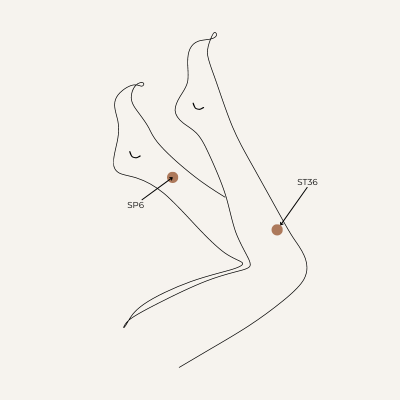
Leg Three Miles (ST36)
Leg Three Miles or ST36 is found around four finger-widths below the kneecap, slightly to the outside of the shinbone.
In Traditional Chinese Medicine, ST36 is often used to support energy, digestion and resilience. It can be a helpful point when you feel depleted, tired or in need of grounding.
Three Yin Intersection (SP6)
Three Yin Intersection or SP6 is found around four finger-widths above the inner ankle bone, close to the inner edge of the shinbone.
In Traditional Chinese Medicine, SP6 is commonly used to support the Spleen, Liver and Kidney channels. It is often chosen in treatments relating to stress, sleep, hormonal balance and emotional wellbeing.
Avoid pressing this point during pregnancy unless guided by a qualified practitioner.
Third Eye (Yintang)
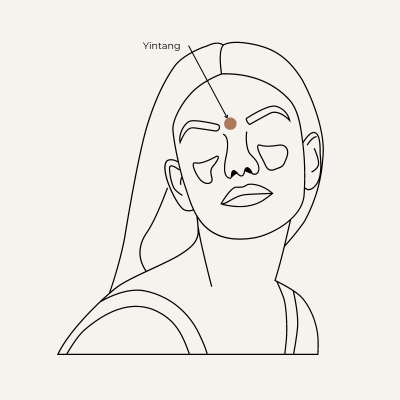
Yintang is located between the eyebrows.
This point is traditionally used to calm the mind and settle the spirit. Many people find it naturally soothing, especially when they feel mentally busy or overwhelmed.
Spirit Gate (HT-7)
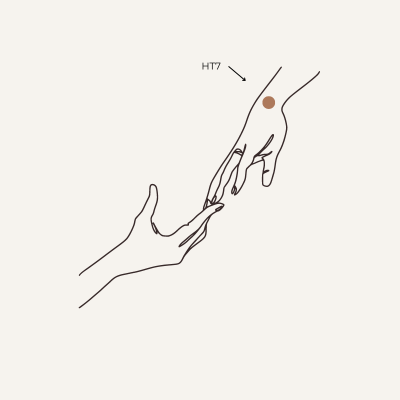
Spirit Gate, or HT7, is located on the wrist crease, on the little finger side.
In Traditional Chinese Medicine, HT7 is commonly used to support emotional balance, sleep and a sense of inner calm.
It can be a lovely point to use when your thoughts feel busy or when you are trying to create a calmer transition into the day.
Why Consistency Matters More Than Perfection
Consistency is key. Change can feel hard because familiar habits feel safe, and our brain naturally looks for predictable patterns.
Even breaking away from a habit you know is not serving you can make you uncomfortable.
If you decide to give this 5-minute habit a go, stick to it for the next 14 days. There will be days when your dopamine reward system will pull you to reach for your phone or get back to sleep. If you notice this, be gentle with yourself and remind your brain that saying your positive affirmation will only take 5 minutes. You can look at that phone or hit that snooze button as soon as you're done with your new morning habit. You may surprise yourself by finding that once you've engaged with your acupressure and your positive affirmation, the urge has passed.
A Note From the Clinic
Many people I work with feel frustrated that they “should” be able to relax, but relaxation is not just a mindset.
It is also a physiological state.
When the nervous system has been under pressure for a long time, it often needs repeated signals of safety before it begins to soften.
Small daily practices, acupuncture and naturopathic support can all help create those signals in different ways.
When You May Need More Support
A morning ritual can be a helpful place to start, but if stress, anxiety, poor sleep, tension, or overwhelm have become part of your everyday life, it may be a sign that your nervous system needs more consistent support.
In clinic, I combine acupuncture with naturopathic, nutrition and lifestyle support to help you understand what your body may be trying to communicate.
Rather than giving you a generic list of wellness tips, the aim is to create a personalised plan that works with your body, your symptoms and your life.
If you would like support with stress, anxiety or feeling constantly on edge, you can explore my acupuncture and naturopathy support below.
I support clients from my acupuncture clinics in Honor Oak and Peckham, combining traditional acupuncture with a modern understanding of the nervous system to support the effects of long-term stress on both the mind and body.
*If you're experiencing mental health symptoms that are disturbing or impacting your day-to-day activities, please reach out to a qualified professional or contact some wonderful charities such as Mind or The Mental Health Foundation for more information and resources.
1. https://pubmed.ncbi.nlm.nih.gov/26541373/
2. https://www.ncbi.nlm.nih.gov/pmc/articles/PMC10813701/
3. https://www.ncbi.nlm.nih.gov/pmc/articles/PMC8071356/
4. https://pubmed.ncbi.nlm.nih.gov/26002571/
5. https://www.ncbi.nlm.nih.gov/pmc/articles/PMC4441788/
Want to Work Together?
Explore my services below or go ahead and book your first appointment.

Subscribe to our newsletter
Acupuncture and naturopathy lifestyle advice straight into your inbox
Copyright © 2026 by Sarah Shorter | Website Disclaimer | Privacy Policy